
Influence runs out before attention arrives
Most of what a company can do about a public debate is done before the debate is visible. A corporation’s work with PR, PA and RA must adapt to an issue’s life cycle.
Every company of any size is part of a public debate whether it chooses to be or not. Its products, its conduct and the consequences of both are discussed by people it will never meet, in arenas it does not control, and some of those discussions end in law. How a company relates to that debate, whether it listens, whether it adapts, whether and when it argues, is a question about how it understands its place in society. It is a communications question only in the sense that communication is where the answer becomes visible.
One way of seeing this is through the issue life cycle, one of the oldest observations in issues management and one of the most often misused. In its simplest form it says that a concern begins outside the political system, becomes a subject of public debate, is taken up by parties and politicians, is worked into a proposal, is adopted as law, and then settles into regulation, supervision and consequence. Anthony Downs described the attention half of this pattern in 1972 and called it the issue-attention cycle. [1]
Practitioners tend to use the model as a calendar. Identify the phase, select the tactic. That is not what it is good for. Its value rests on one structural observation: in many public policy processes, attention and influence tend to move in opposite directions. Room to influence is often greatest when few people are paying attention, while attention is often greatest after much of the room has closed. A second point is less often noticed. The early phases are not primarily a place to argue. They are a place to listen. The model developed below is a practitioner synthesis, combining the issue-attention cycle, public-arena theory, issue-arena thinking and the situational theory of publics.
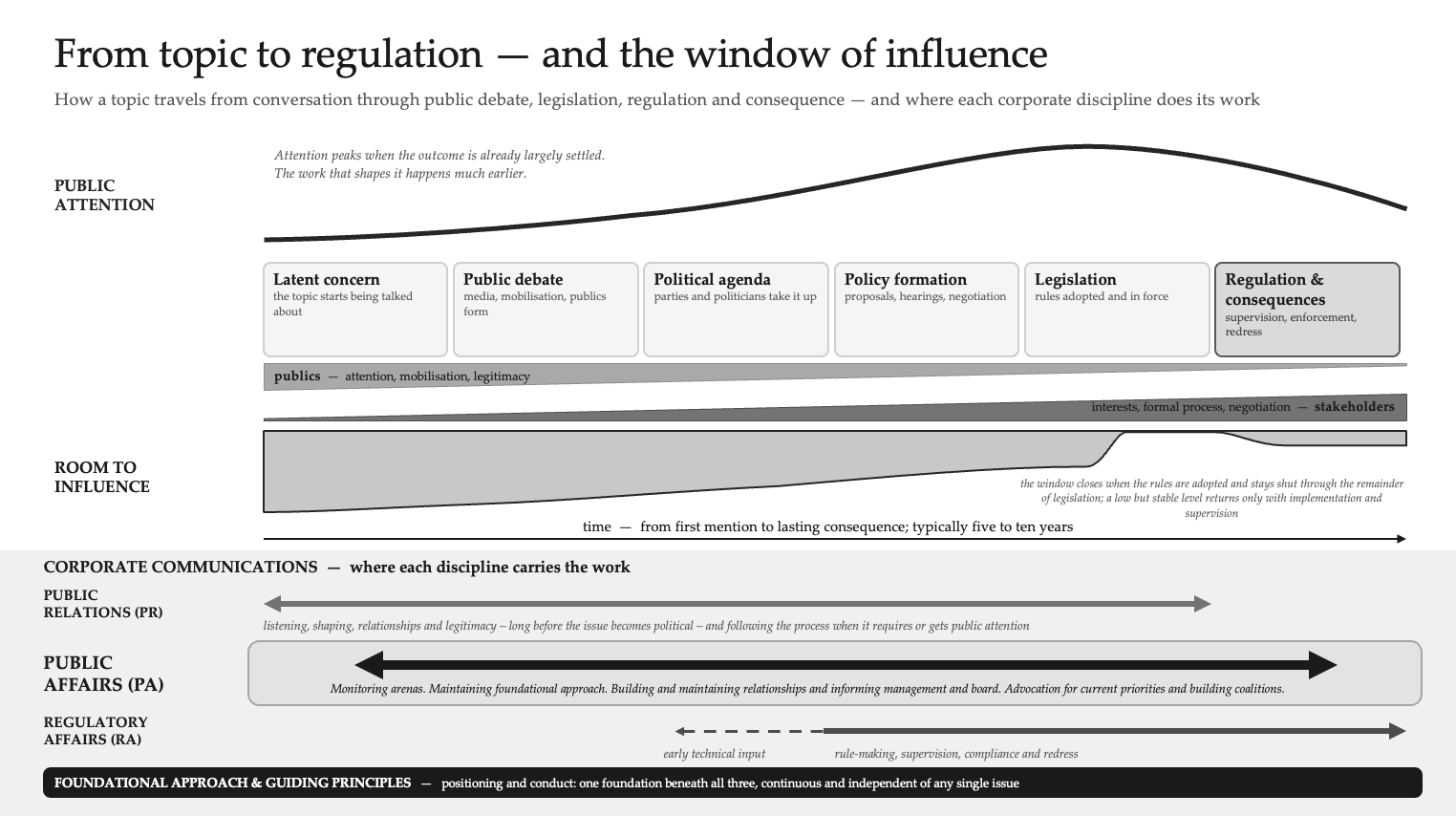
The inverse relation
While a concern is still latent, much of what will later define the issue remains open. The framing is unsettled, no institution owns it, and nobody has taken a position they must now defend. A company present at this point is not lobbying. It is learning what the concern is, from the people who hold it, while there is still time to do something about it.
As the issue moves into public debate and then onto the political agenda, positions harden. Parties commit, coalitions form, and each commitment removes options. By the time a proposal exists, most of the range has been foreclosed. The negotiation concerns what is left.
Attention runs the other way. It is low while the issue is being defined and high while the issue is being decided. This follows from what attention responds to. Media and public interest are drawn by conflict, decision and consequence, and none of these is present while a concern is still forming.
The practical consequence is unwelcome. A function that takes its cues primarily from attention will usually arrive after the point at which it could have mattered most. Monitoring coverage is often a way of learning what is no longer open.
Adoption closes the window
It is tempting to draw the room to influence as a smooth decline, a wedge tapering to a point. That is misleading in a way that matters. Influence does not decay evenly. The main legislative window can close abruptly.
The principal shift happens at adoption. Before the vote, the legislative text is still open to argument. After it, the essential choices embodied in the adopted act are fixed. The main legislative window has closed. What remains is a narrower and more technical scope for influence centred on transposition where relevant, delegated and implementing measures, guidance, interpretation and application.
A narrower scope remains in the final phase, when rules have to be applied. Supervision, guidance, enforcement practice and redress all involve judgement, and judgement can be informed. The level is usually lower and more technical. For most companies that is a working condition. For some industries, as I return to below, it is the main condition.
The arena changes shape
The life cycle describes a trajectory. It does not explain why the trajectory has that shape. Arena thinking does, provided the term is used with care.
An arena, in the sense I use it, is not a place. It is the sum of the settings in which an issue is discussed and of the actors who take part, and it is defined by the issue rather than by any venue. That is the concept Vos, Schoemaker and Luoma-aho [3] brought into corporate communication, with the decisive move that in an issue arena the focal point is the issue, not the organisation. Hilgartner and Bosk [2], writing earlier about institutional settings, supplied the property that makes the concept useful: an arena has finite carrying capacity. Only so much can be salient at once, and issues rise and fall according to selection principles such as drama, novelty and cultural resonance rather than according to how serious they are.
Read this way, the phases of the life cycle are not simply stages in a process through which the issue passes, and the issue does not merely move from one arena to another. The arena changes around it. What changes is who is in it, on what terms they are admitted, how much attention it can hold, and what counts as a valid contribution. In the early phases admission is relatively open, attention is scarce, framing is contested and publics help set the terms. In the later phases admission is more regulated, attention is more secure, the terms are procedural and named actors with standing become more prominent. Adoption marks the point at which the arena’s dominant terms shift from argument to compliance.
This also explains why the life cycle makes a poor calendar. An arena is rarely uniform. The same issue can be procedurally closed among the institutional actors in it and still open among its publics, or the reverse. What the model gives you is not the current phase but a question. Who is in the arena now, on what terms, and are we there?
Publics and stakeholders
The two words are used interchangeably in most corporate practice, and the confusion costs more than it appears to. The discipline that deals with the first of them is called public relations, and the name is precise if it is read in the plural. I use the term in Grunig's sense throughout, as the management of relationships with publics, and not in the colloquial sense of obtaining favourable attention, which I have dealt with in Anti-PR.
Grunig's distinction [4] is the useful one. Stakeholders are broad categories of people who affect the organisation or are affected by it: employees, customers, communities, investors, suppliers. They are defined by consequence, they are relatively stable, and they can be identified before any particular issue arises. A stakeholder map is possible.
Publics are different in kind. A public forms around a problem. People who recognise a problem, see themselves as involved in it and believe they are not wholly constrained from acting begin to seek information and to talk to one another, and in doing so they constitute themselves as a public. The organisation does not select them and cannot bring them into being simply by addressing them. They are specific to an issue and may dissolve when the issue does. Several publics can exist within one stakeholder category and hold opposing positions. In the broader issue-arena sense used here, participation may also arise primarily from the issue rather than from a pre-existing relationship with the organisation.
Placed on the life cycle, the distinction has a clear shape. The early phases belong to publics. A concern becomes an issue when people recognise a consequence as a problem, seek information and organise around it. Latent concern and public debate are the phases in which publics do much of their work, and they are also the phases in which many organisations are absent, because a conventional stakeholder map may not reveal an emerging public.
Institutional stakeholders typically become more prominent in the later phases: named parties with recognised standing, admitted to hearings and consultations because their interests are formally acknowledged. This is where most corporate public affairs is comfortable, and it lies downstream of much of the early framing of the issue.
The shift is one of dominance rather than replacement. Publics do not disappear at adoption. The arena’s terms change and no longer admit them. A public excluded from the formal process does not go away, it keeps talking on its own terms, and that is the mechanism by which an apparently settled issue returns.
Two errors follow from confusing the terms. The first is to treat a public as a stakeholder, inviting it into a consultation designed for stable and negotiable interests when what it holds is a values position that cannot be traded. The second is to treat a stakeholder as a public, addressing a counterpart with a formal role as though attention and framing were the point, when what it requires is documentation.
A third category cuts across both. Rights-holders hold rights whether or not they hold a stake and whether or not a public has formed around them. Their claim does not depend on the life cycle at all.
Listening comes first
The early phases belong to publics, and a public is not an audience. It forms because people have recognised a consequence as a problem and cannot get it addressed. What they most need from the company is not a message about the consequence. It is a change in the consequence.
This is where the life cycle connects to the paradigm that runs through the rest of this collection. Corporate communication is a two-way process that brings together information and relationships, and its most difficult part is listening: listening that changes decisions and conduct, not listening as a courtesy. Grunig's point is direct. Communication with publics before decisions are made resolves more than anything done after, because it lets management take decisions that are less likely to produce the consequences publics make issues of. A company that hears a public early has a choice a company that hears it late does not. It can adapt.
Adaptation covers a wide range. At one end are changes to what the company does: a product withdrawn or redesigned, a service altered, a practice stopped, a site not built. In the middle are adjustments: timing, terms, mitigation, compensation, how a change is introduced and to whom. At the other end is changed communication, where the concern rested on a misreading and what changes is the explanation. All three are legitimate outcomes of listening. The third is legitimate only as an outcome. A function that arrives every time at the conclusion that the company needs to explain itself better was not listening. It was waiting to speak.
Which end of the range is right depends on what kind of concern it is. As I argue in Issues management is about relationships, not publicity, the decisive distinction is between a concern of knowledge and a concern of values. On a question of knowledge, the company usually knows more than the public about the technical facts of its own operation and listening serves to find out what has been misunderstood and what has not. On a question of values, the public knows something the company cannot know from inside: how the consequence is experienced, what it touches, and what will and will not be accepted. On those questions the issue is not whether the company is right but whether it is permitted, and to a values concern the answer that the rules were followed is not a defence. The common error is to assume a question of knowledge when one is facing a question of values.
Listening brings two kinds of knowledge into the company: intelligence about the environment, and knowledge of the company’s own effects on people and society. Both find a regulatory counterpart in the double-materiality principle under CSRD, which requires a company to assess both its impacts on people and the environment and the financial effects of sustainability matters on the company. That assessment depends on evidence beyond the organisation itself; I have set out what that means for boards in CSRD formalises listening. Intelligence that changes nothing is surveillance, recognition that learns nothing is sentiment, and listening is the discipline that holds the two together.
Adaptation is the form of influence the concept of an issue life cycle hides. It never appears on the chart, because a concern that has been met does not become an issue. There is no debate to win. The public disperses, or never forms, and that particular cycle does not run. From the outside it looks as if nothing happened. From the inside it is the most valuable outcome the function can produce, and it is often also the most valuable commercial intelligence the company receives that year.
Symmetry is the standard here. I have argued elsewhere that pure symmetry is a regulative ideal rather than a description of practice, and the point stands. The right posture in the earliest phases is to listen first, establish what kind of concern one is facing, change conduct where the concern is warranted, adjust where it is partly warranted, and explain where it is not. Advocacy is what remains after listening has done its work. It is not a substitute for it.
What legislation is for
None of this should be read as saying that legislation is what happens when a company fails to manage an issue. That reading is common in corporate practice, and it is too small. Legislation is how a society settles what it needs settled: which risks it will accept and which it will not, who carries them, and on what terms an activity may continue. Most of what ends up in law is not the company's to resolve. It concerns competing interests, shared resources and standards that no single actor can set for itself.
Companies and industries often want new rules. A standard that applies to everyone removes the disadvantage of being the only one to meet it. Legal certainty allows investment. A regime that raises the cost of cutting corners protects those who do not cut them. The ready-to-eat food producer whose position rests on product integrity has every reason to welcome a regulation that makes integrity mandatory, because it turns a claim into a condition of the market.
Wanting a law is not the same as accepting whichever law arrives. A company that wants regulation wants it in a form that works, and it will have views on that form for two reasons, both of them legitimate. The first is interest: it will live with the consequences. The second is competence: on the technical facts of its own operation it usually knows things the legislator does not, and a rule written without that knowledge is likely to be a worse rule. Neither reason is a licence. Interest declared is legitimate. Interest presented as expertise is not. The foundational approach is what keeps the two apart, because it fixes in advance what the company will and will not argue for, whichever rule is on the table.
This is why the window of influence matters in both directions. It is the period in which a company can help a society get a rule right, and not only the period in which it can protect itself from one.
One foundation, three functions
That sequence needs an anchor. A company cannot decide issue by issue what it stands for, and a public will notice if it tries. The anchor is the foundation.
In the framework I set out in Strengthening public affairs by supplying a solid framework, the work sits at two levels. Below the line are the foundational approach and the guiding principles. They follow from the defining characteristic of the industry and the structural exposure that comes with it, and they govern positioning and conduct across issues and political cycles. Above the line sit the current priorities, which are time-bound and derived from the agenda. Without the foundation, public affairs is a lobbying calendar: a diary of meetings organised around whatever is currently in play.
It is tempting to treat the foundation as a public affairs device, since public affairs is the function whose collapse into a calendar is easiest to see. That reading is wrong. Every link in the chain from defining characteristic to structural exposure to foundational approach is a fact about the company (and its industry), not about a department. The foundation sits beneath public relations, public affairs and regulatory affairs alike, and none of the three owns it.
What differs between them lies downstream. The counterpart differs, and with the counterpart the evidence required and the register. A ready-to-eat food producer whose foundational approach is an uncompromising commitment to product integrity demonstrates it to a retail buyer with test data, to a supervisory authority with evidence of systemic control, and to a public with conduct that holds when something goes wrong. The posture is one. The proof is three.
Nothing compels this. A company can run three functions with three postures, and many do, because each faces a different counterpart and each adapts to it. A company is present in many arenas, one for each type of issue that concerns it, and in ordinary conditions they are distinct enough that nobody notices. A crisis removes that protection. The crisis issue floods every arena the company is in, the boundaries between them become porous, and a statement written for one is read in all of them. Differences that looked like adaptation are then read as inconsistencies, and inconsistencies are read as dishonesty. A single foundation is not a preference for tidiness. It is what allows a company to say the same thing everywhere and be believed in each place.
The foundation does not belong to the cycle at all. It is what a company works on when no issue is open, which is also when its conduct is least likely to be read as tactical.
What this asks of the function
Three disciplines within corporate communications work across the cycle. They rest on the same foundation, but their distinctive contributions become prominent at different points.
Public relations enters first. Its counterpart is the public, in the plural sense, and its work is the two-way work described above: listening systematically rather than occasionally, maintaining relationships before they are needed, bringing what publics say into decisions, and only then contributing to how the concern is framed. The output is conduct that will bear examination when examination comes. The message follows from it.
Public affairs carries the middle, where the issue has entered political institutions, the counterparts include stakeholders with recognised standing, and the decision is still open. Its priorities are time-bound. The position from which it argues is not.
Regulatory affairs contributes throughout the cycle but becomes particularly important as policy is translated into detailed rules and supervisory practice. It follows regulation, supports adaptation and makes the case for justified adjustments. In some industries this is a permanent condition rather than a final phase. Pharmaceuticals and medical devices, banking, insurance and payments, telecommunications, energy, aviation, food, chemicals and information technology all operate under rules that are revised continuously, supervised actively and enforced with consequence. For them, the lower and more technical level of influence that remains after adoption is where much of the work is done, and one cycle rarely ends before the next begins. Technical input during policy formation is part of this. So is the daily interpretation of rules already in force, and the case, built over years, for changing them.
The value of the life cycle is not that it tells you what to do in each phase. It is that it allows one diagnostic question to be put to your own organisation. At which phase do we typically first become aware of an issue that will affect us? If the honest answer is the political agenda or later, the organisation is structurally late, and no amount of skill in the closing phases will compensate. The remedy is not better lobbying. It is presence in the arenas where concerns are still forming, a willingness to hear them and to change conduct in response, and a foundation that makes the response credible.
My thinking on corporate communications is laid out here: www.jorgenchristiansen.no/how
[1] Anthony Downs, Up and Down with Ecology: The Issue-Attention Cycle, The Public Interest 28, 1972. https://gwern.net/doc/sociology/1972-downs.pdf
[2] Stephen Hilgartner and Charles L. Bosk, “The Rise and Fall of Social Problems: A Public Arenas Model”, American Journal of Sociology 94(1), 1988, pp. 53–78, https://www.researchgate.net/publication/225089658_The_Rise_and_Fall_of_Social_Problems_A_Public_Arenas_Model
[3] Marita Vos, Henny Schoemaker and Vilma Luoma-aho, “Setting the Agenda for Research on Issue Arenas”, Corporate Communications: An International Journal 19(2), 2014, pp. 200–215, https://www.researchgate.net/publication/262575124_Setting_the_agenda_for_research_on_issue_arenas
[4] James E. Grunig and Todd Hunt, Managing Public Relations, Holt, Rinehart and Winston, 1984; James E. Grunig, Paradigms of global public relations in an age of digitalisation, PRism 6(2), 2009 https://www.researchgate.net/publication/303153523_Paradigms_of_global_public_relations_in_an_age_of_digitalisation