
Strengthening public affairs by supplying
a solid framework
Without a foundation, public affairs is merely a lobbying calendar.
Effective public affairs work needs a solid framework anchored in top management. Without such a framework, engagement with policymakers risks becoming reactive, fragmented, or driven by single issues. This short document describes such a framework with examples from two industries. The framework is illustrated below.
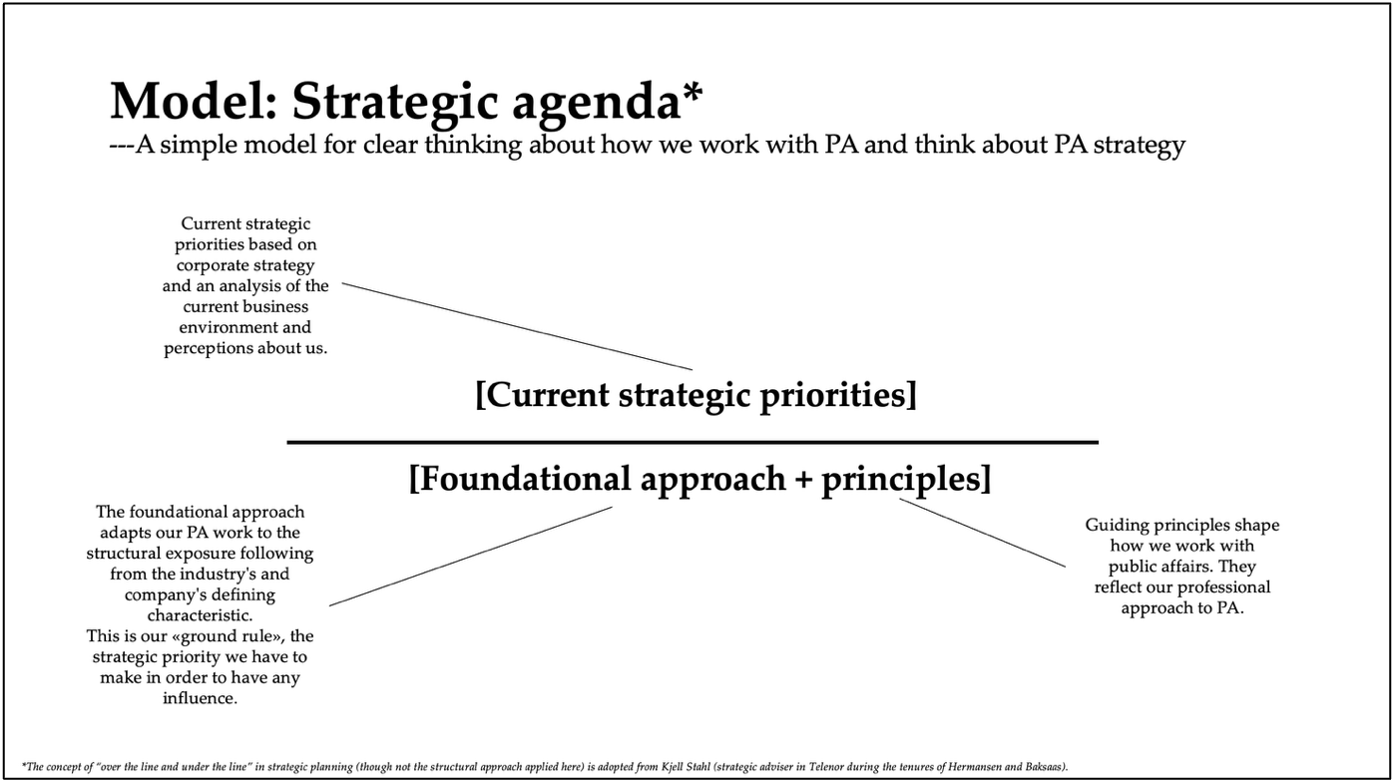
The model distinguishes between two levels of public affairs work.
The foundation, shown below the line, consists of the company’s foundational approach and guiding principles. These define how the company engages with policymakers and how it positions itself in relation to the structural characteristics of the industry.
Above the line sit the current strategic priorities, which reflect the external political and regulatory agenda and the company’s immediate advocacy needs.
Public affairs work primarily takes place above the line. However, effective engagement requires that current priorities remain anchored in the foundation. This ensures that day-to-day advocacy strengthens long-term credibility and influence.
Without a clear foundation, strategic priorities risk becoming reactive or opportunistic. Conversely, a foundational approach as a basis for strategy without current strategic priorities becomes abstract and disconnected from real advocacy work.
The purpose of this framework is therefore practical: to ensure that our day-to-day public affairs work consistently reinforces the company’s long-term strategic position and credibility.
The foundation – why we need principles
The foundation consists of two elements: guiding principles and a foundational approach.
Guiding principles govern conduct. They ensure that our work is professional, disciplined and credible regardless of the issue at hand.
Importantly, principles are not situational or tied to individual policy debates or regulatory processes. They apply across leadership teams, industries, issues, regulatory environments and political cycles.
Principles serve two functions.
First, they provide discipline and consistency in how we engage externally. Second, they ensure that advocacy efforts reinforce credibility over time.
The foundation – why we need a foundational approach
While principles define how we engage, the foundational approach defines the conduct required by our structural position. Influence follows from maintaining that conduct over time.
Public affairs ultimately depends on legitimacy. Policymakers are more likely to listen to companies whose positions are consistent, predictable and grounded in a clear understanding of the industry’s role in society.
Every industry has a defining characteristic that shapes how it is perceived and why it attracts political attention.
Two examples illustrate this point:
For an aquaculture company, it is that it produces food in the commons – under water, largely out of sight – in an environment where many actors have legitimate rights and interests.
For a ready-to-eat food producer, it is that it places products directly on the consumer’s plate without further safety barriers.
From the defining characteristic follows a structural exposure that companies cannot avoid.
Our two example industries illustrate this:
Producing food in the commons implies that people – always – will be anxious about potential harm to the environment and to shared resources.
Ready-to-eat food implies existential food safety exposure and immediate trust consequences.
A foundational approach is the company’s long-term response to this structural exposure. By foundational, we mean that it follows from the defining characteristic of the industry, it responds to the structural exposure the companies in the sector face, it is relatively stable and rarely changes and it defines the long-term strategic posture required to maintain legitimacy and influence.
Our two example industries illustrate this:
In aquaculture, the foundational approach is to consistently demonstrate care for the marine environment and for local communities.
In ready-to-eat food production, the foundational approach is to demonstrate uncompromising commitment to product integrity and safety.
In essence, the foundational approach answers the question: What must we consistently prioritise in order to maintain legitimacy and influence, and then to be listened to?
How we develop current strategic priorities
While the foundation defines the long-term orientation, our day-to-day operations follow from current strategic priorities – what we focus on now.
These are derived from a situational analysis based on:
The corporate strategy.
The external political and regulatory agenda.
Industry developments, including technological changes.
Market developments and changes to the competitive landscape.
Reputational and societal perceptions.
Unlike the foundation, these priorities are time-bound and dynamic.
A sustainability debate, a regulatory development, a technological breakthrough or a market shift may become a priority for a defined period.
This is the level where advocacy and operational public affairs work take place.
However, current priorities must always be consistent with both the foundational approach and the guiding principles.
In some situations, a key priority may be to reposition the company so that it is better aligned with its principles and foundational approach.
If short-term priorities contradict the foundation, credibility erodes. If they ignore current realities, influence disappears.
My thinking on corporate communications is laid out here: www.jorgenchristiansen.no/how