
The structural turn in public affairs
Integrating communicative paradigm, strategic foundation, and arena dynamics.
Effective public affairs work requires answers to three questions. How should we engage? On what basis should we engage? And where does engagement actually take place? The dominant traditions in public relations theory and political communication each answer one of these questions well, but none answers all three.
The result is that most public affairs practice operates without a framework that connects communicative principles to strategic positioning to the realities of political and regulatory terrain.
This essay presents a framework that integrates the three traditions into a single model.
Three traditions, three limitations
The communicative paradigm
Grunig’s Excellence theory[1] and its core prescription of two-way symmetrical communication provides the most rigorous answer available to the question of how organisations should communicate with their publics. Communication should be research-based, dialogical, and designed to bring information from the external environment into organisational decision-making. The organisation participates in decisions rather than merely conveying messages about decisions already made.
This is correct as far as it goes. But it does not go far enough.
Grunig tells us that public relations should be a bridging function rather than a buffering function, but he does not specify what the bridge should be anchored to on the company’s side. The paradigm is universal: it applies equally to any industry, any company, any political context. This universality is its strength as a theory and its weakness as a strategic tool. A public affairs professional who adopts the two-way symmetrical model knows how to engage, but not about what, from what position, or why that position and not another.
Arena thinking
The public arenas model, originating with Hilgartner and Bosk[2] and extended into corporate communication by Vos, Schoemaker, and Luoma-aho,[3] provides a powerful description of where issues are contested. Arenas are structured contexts of conversation, position and power with finite carrying capacities. Issues compete for attention within and across arenas according to selection principles: drama, novelty, cultural resonance, political alignment. Feedback loops between arenas amplify or dampen issue salience. The arena model explains the dynamics of the political and regulatory environment that public affairs professionals must navigate.
But arena thinking is descriptive, not prescriptive. It tells us how issues rise and fall, not what a company should do before entering an arena. It explains the terrain but provides no basis for strategic positioning within it.
A public affairs professional who understands arena dynamics knows that attention is scarce and that issues compete but still lacks a method for determining what position to take, why that position is credible, or how it connects to the company’s long-term political standing.
Issues management and stakeholder theory
The broader literature on issues management and stakeholder theory provides important concepts – issue life cycles, stakeholder identification, framing, legitimacy – but tends to operate at the level of individual issues or bilateral relationships. Most stakeholder models place the organisation at the centre and arrange stakeholders around it, which inverts the actual power dynamic in political and regulatory contexts. Issues management literature acknowledges the importance of the external environment but typically treats the company’s response as reactive: monitor, assess, respond. It does not provide a structural account of why the company is exposed in the first place.
The integration
The framework presented here integrates these three traditions into a single model for public affairs strategy. It does so by introducing a structural layer between the communicative paradigm and the arena environment, a layer the existing literature does not provide.
The structural layer
The structural layer begins with a diagnostic question: What is the defining characteristic of this industry? Not the feature the company finds most commercially attractive, but the structural fact that creates its most fundamental political exposure: the characteristic that, if handled badly, would cause the company to lose its right to operate and therefore its right to be heard.
Two examples illustrate this. For an aquaculture company, the defining characteristic is that it produces food in the commons, under water and largely out of sight, in an environment where many actors have legitimate rights and interests. For a ready-to-eat food producer, it is that it places products directly on the consumer’s plate without further safety barriers.
From the defining characteristic follows a structural exposure: the permanent political and societal anxiety that attaches to the industry because of how and where it operates. Producing food in the commons implies that people will always be anxious about potential harm to the environment and to shared resources. Ready-to-eat food implies existential food safety exposure and immediate trust consequences.
From the structural exposure follows a foundational approach: the company’s long-term strategic posture: what it must consistently demonstrate to keep the legitimacy that makes policymakers willing to listen. In aquaculture, the foundational approach is to consistently demonstrate care for the marine environment and for the local communities living in, of and with this environment. In ready-to-eat food production, the foundational approach is to demonstrate uncompromising commitment to product integrity and food safety.
This chain, from defining characteristic to structural exposure to foundational approach, together with principles constitutes what the framework calls the foundation: the below-the-line strategic layer that is relatively stable, rarely changes, and is not derived from the current political agenda.
Identifying the defining characteristic
Leadership teams will often propose several candidates for the defining characteristic. Each framing implies a different foundational approach and a different positioning towards policymakers. The test is: which characteristic, if handled badly, would cause the company to lose its right to operate, and with it its standing with policymakers? That is the defining characteristic. It is not the feature the company finds most appealing or most commercially interesting. It is the structural fact that creates the company’s most fundamental political exposure.
Getting this wrong means building public affairs on a foundation that cannot hold. The company will advocate on the wrong issues, frame its positions incorrectly, and fail to build the kind of credibility that makes policymakers listen.
Guiding principles
The foundation consists of two elements: the foundational approach, which defines where the company must position itself, and guiding principles, which define how it engages. Principles govern conduct. They ensure that public affairs work is professional, disciplined, and credible regardless of the issue at hand. Unlike strategic priorities, principles are not situational or tied to individual policy debates. They apply across leadership teams, industries, issues, regulatory environments, and political cycles and ensure consistency.
Consistency is a necessary condition for credibility.
The relationship between principles and foundational approach is particularly important, and particularly exposed to tension. Advocacy work frequently involves situations where a commercially attractive position conflicts with what the foundational approach demands. A company that has built its legitimacy on environmental responsibility cannot credibly lobby for regulatory exemptions on environmental grounds, even when the short-term economics are compelling.
When such conflicts arise, the foundation takes precedence. The reason is structural: the foundational approach derives its political force from the company’s credibility, which the principles protect. A company that advocates without principled conduct will be heard once. A company that advocates with it will be heard repeatedly.
Current strategic priorities
Imagine a simple visualisation of this thinking with a horizontal line. Below the line sits the foundational approach and the principles. Above the line - resting on the foundation - sit the current strategic priorities, which are dynamic, time-bound, and derived from the intersection of corporate strategy, the external political and regulatory agenda, industry and technological developments, changes to the competitive landscape, and reputational and societal perceptions. This is the level at which day-to-day public affairs work takes place, and where arena thinking becomes operational. This model is described in detail here.
A sustainability debate, a regulatory development, a technological breakthrough or a market shift may become a priority for a defined period. However, current priorities must always be consistent with both the foundational approach and the guiding principles. In some situations, a key priority may be to reposition the company so that it is better aligned with its own foundation.
If short-term priorities contradict the foundation, credibility erodes. If they ignore current realities, influence disappears.
The arena dimension
A foundational approach does not exist in the abstract. It is tested and expressed in the arenas to which the company is structurally exposed towards regulators, customers, media, employees, or the public. The company does not choose its arenas. Its defining characteristics and structural exposure make participation in some arenas inevitable: Arenas determine how the foundational approach is expressed, what evidence is required, and what register is appropriate.
A ready-to-eat food producer demonstrating product integrity will communicate very differently with a retail buyer, who needs documentation and test data, than with a regulator, who needs evidence of systemic control, or a journalist, who needs a credible narrative. The foundational approach is constant. The arenas determine how it is made visible.
Situational analysis determines where engagement is most needed now, not which arenas exist. An arena-analysis answers a question the foundational approach alone cannot: where do we need to engage, with whom, right now?
What the integration produces
It grounds the communicative paradigm in structural reality. Two-way symmetrical communication becomes credible, rather than performative, when it is anchored in the company’s foundational approach. A company that engages in genuine dialogue about the issues arising from its defining characteristic is doing something structurally different from a company that practises “stakeholder engagement” as a communications exercise. The foundational approach specifies what the bridge connects to. Without it, the bridging function has no fixed anchor.
It makes arena thinking strategic. The foundation determines which arenas the company is present in and what position it must hold within them. Current strategic priorities identify specific arenas and issues based on the external environment, but these priorities are always tested against the foundation. This prevents the common failure mode of public affairs work: reactive engagement driven by whatever issue is currently loudest, without reference to a coherent long-term position.
It explains why most public affairs work fails. Public affairs without a structural foundation is activity without direction. The company responds to issues as they arise, takes positions that reflect short-term commercial interests, and wonders why its advocacy lacks authority. The framework identifies the root cause: the absence of a foundation derived from the company’s structural exposure. Without this foundation, public affairs is not strategy. It is a lobbying calendar.
It joins principles to strategy. Principles govern how the company engages; the foundational approach governs where it positions itself. When the two collide with a commercially attractive position, the foundation takes precedence, for the reason set out above: its political force rests on a credibility the principles protect.
What this framework is not
This is a framework for strategic positioning in a political and regulatory context. It determines whether public affairs work has a coherent foundation and a clear focus at any given time.
It is not a stakeholder map, a regulatory process guide, or a lobbying playbook. Those are important tools, but they belong downstream. Used without the strategic foundation described here, they produce activity without direction and advocacy without authority.
The framework in summary
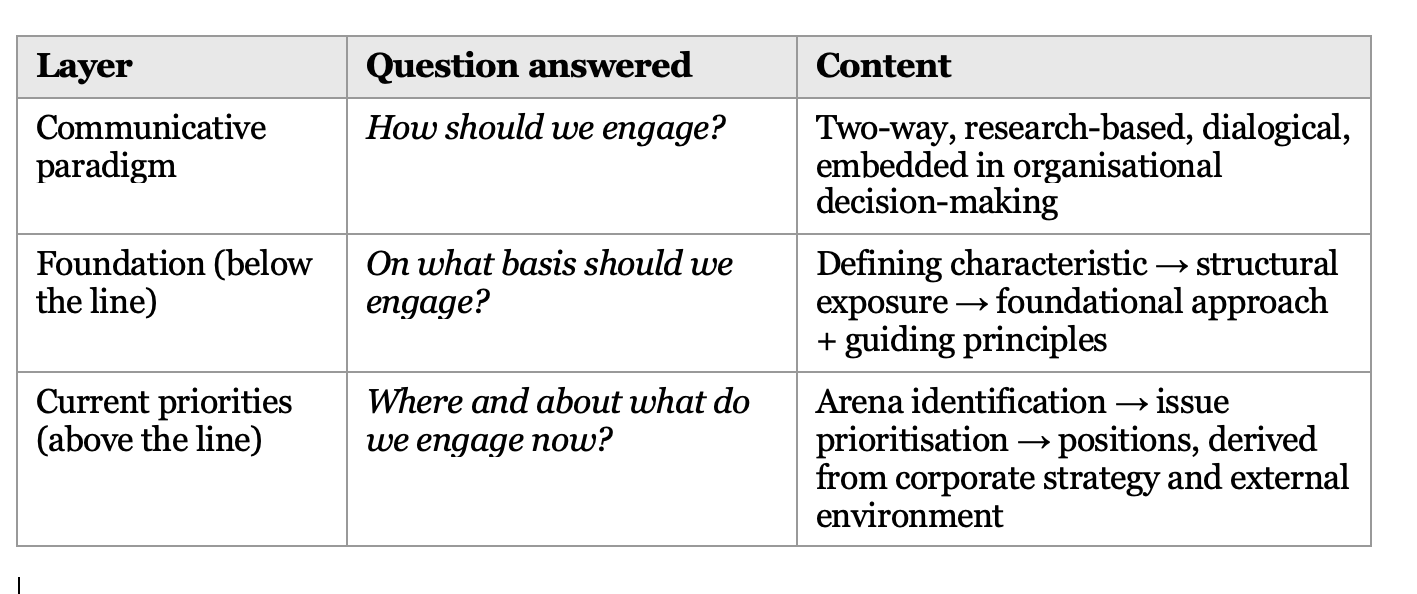
The three layers are interdependent. The communicative paradigm without a foundation produces dialogue without authority. A foundation without arena awareness produces strategy disconnected from political reality. Arena engagement without a foundation produces activity without direction. The framework requires all three.
My thinking on corporate communications is laid out here: www.jorgenchristiansen.no/how
—-
[1] James E. Grunig and Todd Hunt, Managing Public Relations, Holt, Rinehart and Winston, 1984; James E. Grunig (ed.), Excellence in Public Relations and Communication Management, Lawrence Erlbaum, 1992; for a retrospective statement of the paradigm, James E. Grunig, Paradigms of global public relations in an age of digitalisation, PRism 6(2), 2009.
[2]Stephen Hilgartner and Charles L. Bosk, The Rise and Fall of Social Problems: A Public Arenas Model, American Journal of Sociology 94(1), 1988.
[3]Marita Vos, Henny Schoemaker and Vilma Luoma-aho, Setting the Agenda for Research on Issue Arenas, Corporate Communications: An International Journal 19(2), 2014.